The capital to rebuild.
Nearly 11 million people, and basic needs still unmet.
Demand that is not being met.
Greater Kinshasa has nearly 11 million inhabitants, according to the United Nations.
Yet many of its neighbourhoods are still not connected to piped drinking water, and only one Congolese in five has access to electricity. The demand is there. It is not being met.
Four priorities for the capital.
Water from the tap
Reduce network losses, which waste a large share of the water produced, then connect the neighbourhoods that have never been served.
A capital with power
Connect Kinshasa to the power of Inga and to solar plants, so that households, schools and businesses have electricity all day.
Crossing the city
A five-line suburban rail network, starting with the busiest route, to cut hours of daily travel.
Link the capital to the sea
The deep-water port of Banana is due to open its first phase in 2027. Modernise the Banana-Matadi-Kinshasa road and rail link so that the capital benefits.
A capital that decides, provinces that produce.
Kinshasa now concentrates almost everything: the State, trade, businesses. A capital that can no longer move is a capital that governs badly.
- Technical ministries in the provinces. Agriculture in Kasai, Mines in Katanga, Public Works in Matadi. Defence, Foreign Affairs and the Interior stay in Kinshasa.
- A five-line suburban rail network, 40 to 60 km long, linking the centre to the new hubs: administration in Limete, industry in Kinsenso, the university in the north. Heavy goods vehicles use dedicated routes, outside the city centre.
- A digital land registry. Every plot identified, every owner given a clear title. No new neighbourhood opened without water, electricity, roads and sanitation.
- Well-equipped secondary cities (university, hospital, logistics hub), so that growth is no longer concentrated in Kinshasa alone.
Goal: cut the time spent travelling each day by two thirds by 2035.
Source: The March of the Giant (volume 2), chapter 9 bis.
The first ground for applying the Master Plan.
Kinshasa will be the first ground for applying the Master Plan.
Like every reform, every project there will start with a public audit, and its contracts will be published. Results will be measured and made public before what works is extended to the rest of the country.
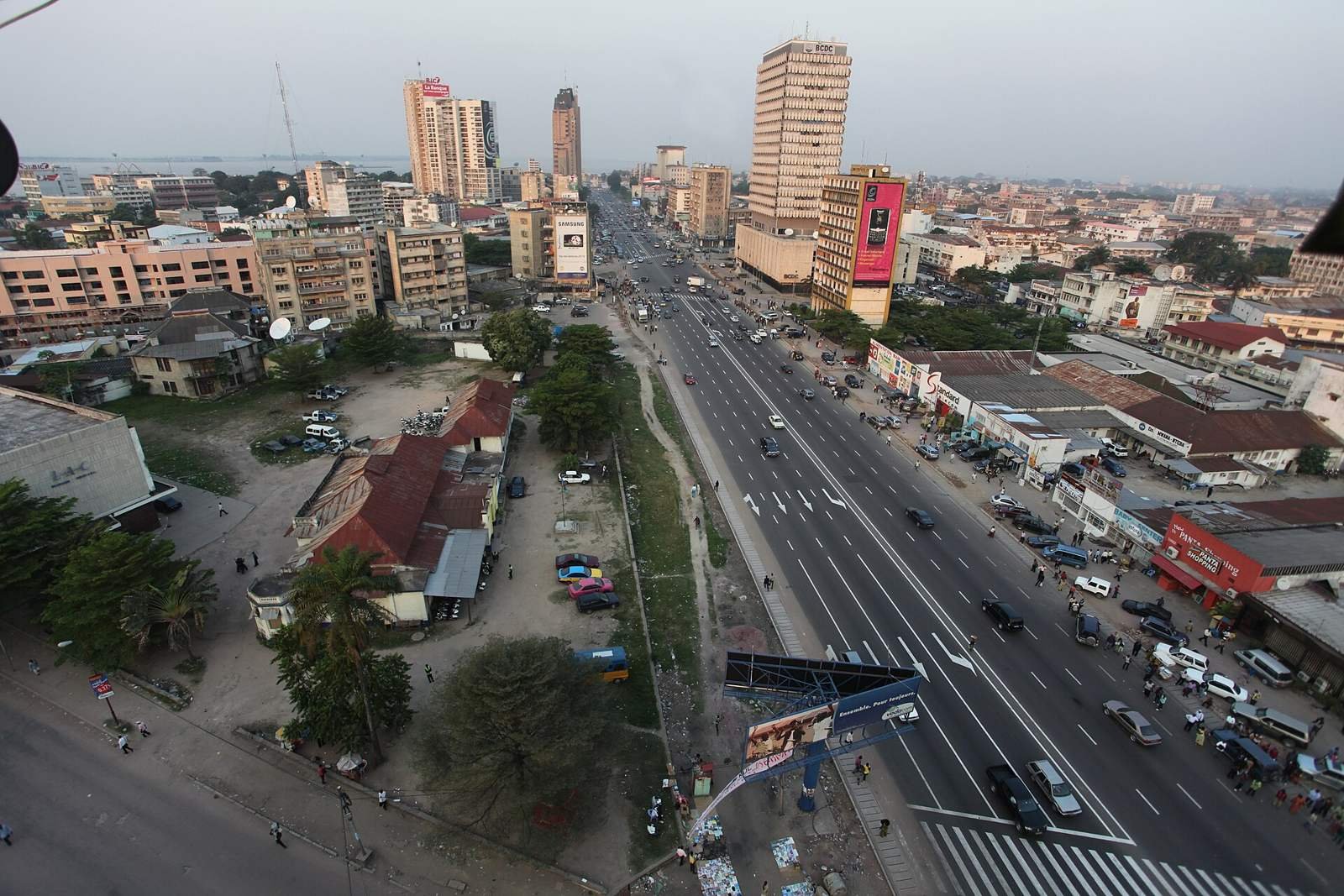
Sources: United Nations, World Urbanization Prospects 2025; World Bank; DP World. Header photo: Boulevard du 30 Juin, MONUSCO/Myriam Asmani, CC BY-SA 2.0 licence.
The future does not wait.
Get the Master Plan free and discover the full plan, chapter by chapter.