Dream tomorrow, build today.
The Master Plan organises Congo's recovery. It links institutions, national production, energy and defence in a single strategy, with named people in charge and results made public.
“Congo needs a State that keeps its course when leaders change, with institutions that protect citizens and |leaders who answer| for their results.”
What holds Congo back.
Congo has the water, the land and the minerals a modern economy needs.
Yet much of this wealth leaves the country unprocessed. Meanwhile, millions of Congolese live far from the schools, healthcare, electricity and security the State ought to guarantee them.
If this divide has lasted since independence, it is because the State changes course every time its leaders change. Institutions lack continuity, decisions are rarely evaluated, and public money still escapes citizens' scrutiny.
I am looking at the State that will have to be rebuilt, stone by stone.
Joshua Nkombe, op-ed “An alternative is not declared. It is prepared.”, 31 July 2026.
A State that outlasts those who lead it.
This idea runs through all four volumes of the Master Plan.
Continuity
Major national policies carry on when the government changes.
Accountability
Every institution publishes its objectives, budget and results, and citizens can look them up.
Control
Resources, public data and strategic infrastructure stay under national control.
Merit
Public posts are awarded on known, verifiable criteria, overseen by a National Council for Selection and Merit.
Limit power before exercising it.
Two presidencies that had nothing in common faced the same temptation. As the end of the term approached, the question of staying in power came back, through postponement or through rewriting. The problem is not the man. It is the structure.
Others talk of a new Constitution in order to stay. We want the Fourth Republic for the opposite reason: to lock power at the source. Its first law says so plainly.
Power is limited, in law and in fact. No legal, political or referendum mechanism can lift this limit. No one owns it. Everyone holds it only temporarily and under constraint.
This architecture was written before power is exercised. The rules will not be adjusted to personal circumstances. They will apply, including to the person who wrote them: two terms at most, a limit no referendum can lift. The final decision on the country's name belongs to the people.
- Electoral legitimacy. The president is elected by direct universal suffrage. The term is limited, defined and cannot be changed.
- Legitimacy through results. Every promise becomes a contract with the people: measurable, traceable and public.
- Institutional legitimacy. Power does not reside in a man. It resides in an architecture that outlives the people who serve it.
The 12 laws of the Fourth Republic
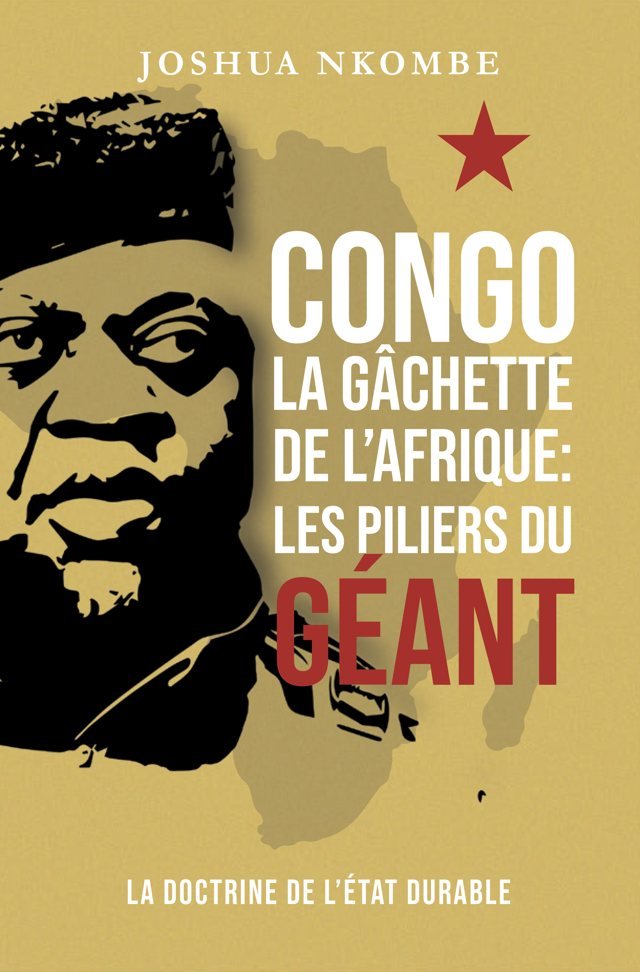
Joshua Nkombe, The Pillars of the Giant (volume 4), preface, chapters 1 to 3 and “The 12 laws of the Fourth Republic”.
Protect and build.
The left arm is the army. It protects. The right arm is the economy. It produces, it builds, it turns resources into real power.
At the centre, the president. Not a strongman: a conductor, guided and constrained by the institutions. A giant without a left arm cannot defend itself. A giant without a right arm can defend itself, but builds nothing.
Transparency, innovation, ambition.
The Master Plan sets them out in its foreword. Here is what they mean in practice.
Transparency
The budgets, contracts and results of every administration are published. Someone living in Kananga should be able to check what was done with their province's money.
Innovation
Digital tools bring public services closer to the most isolated provinces, and schools prepare people for the jobs Congo's economy will need.
Ambition
Singapore and South Korea turned themselves around within a generation. Congo can do it too, if it adapts their methods to its own reality.
Processing our resources in Congo.
Independence starts with control of our strategic resources.
Their exploitation must fund the country's development, and processing them must create work in Congo. With our foreign partners, the rule will be simple: every agreement passes skills on to Congolese people.
Four measures will make this rule real:
- publication of every mining contract;
- mandatory local processing, sector by sector;
- technology transfer written into every agreement;
- a national fund, audited every year, to invest the revenue from strategic resources.
None of this will work without women and men trained to carry it out, and able to turn down corruption.
From plan to execution.
Every reform will start with a public audit of the situation.
Solutions will first be applied in a few pilot provinces. Their costs and results will be published, and the decision to extend them to the rest of the country will be taken on those facts. A policy that fails will be corrected before it is rolled out.
The Master Plan devotes a whole chapter to these pilot zones (chapter 19). This method avoids rolling out, nationwide, a reform that has never been tested.
Three immediate priorities.
Rebuilding our institutions
Without solid institutions, no reform lasts long. We want elections secured by biometrics, party funding made public, an independent judiciary and real protection for whistleblowers.
- For you: follow how public money is used and find accessible justice in your province
- Mobile courts in rural areas
- Appointments on merit, overseen by an independent council
Education as an engine
Schools come first. The Master Plan plans 6 to 7 billion dollars a year to build 5,000 new schools and renovate 3,000 existing ones by 2030, train 500,000 young people in digital skills and open 500 vocational training centres.
- For you: an equipped school near your home, and training that leads to a job in demand in your region
- Free schooling for every child
- Teaching in national languages in technical centres
An economy serving the people
The DRC accounts for about three quarters of world cobalt production (USGS, 2025) and has some 80 million hectares of arable land, only a small share of which is farmed (FAO). We want this wealth processed at home, creating jobs in the country.
- For you: a job in a Congolese production chain
- Refining and processing cobalt in Congo
- Farm mechanisation and food self-sufficiency
The capital to rebuild.
Nearly 11 million people, and whole neighbourhoods without piped drinking water.
Kinshasa will be the first ground for applying the Master Plan: water, energy, mobility and the corridor to the sea.
Choose your priority.
Recovery starts with a decision. Read the doctrine, choose the priority you can contribute to and join the team in your province.